 ..Special
Announcements...
..Special
Announcements...
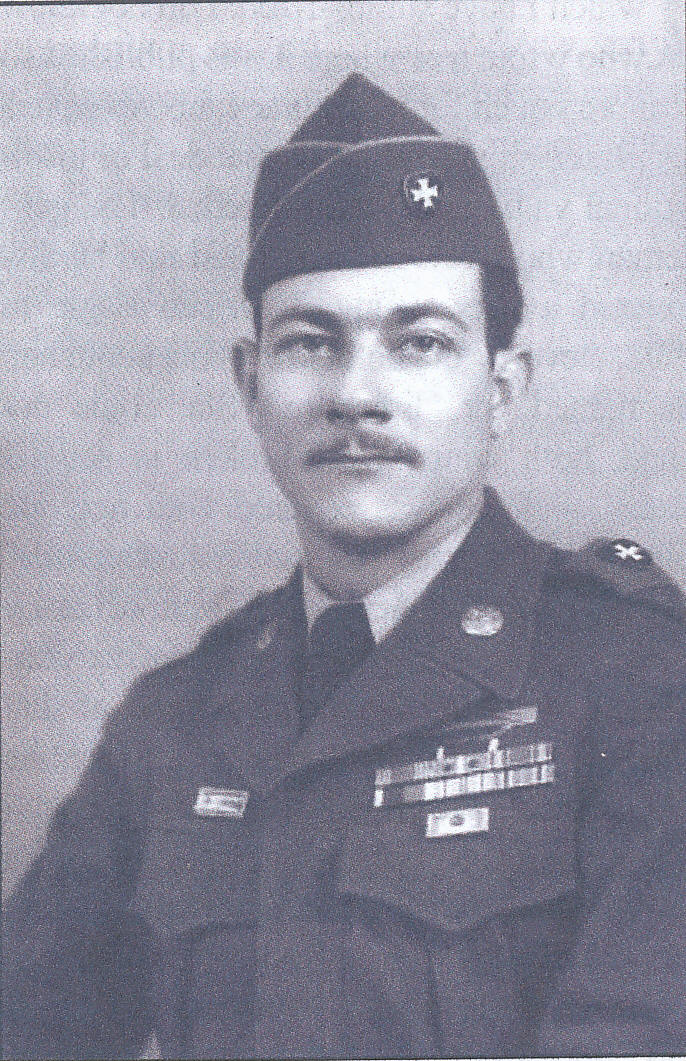
Chief Warrent officer Pastor Figueroa Rodriguez
Aug 6, 1897 - Aug 22, 1979
C.W.O Pastor Figueroa Rodriguez #355390, son of Evaristo Figueroa and Julia Rodriguez was born on August 6, 1897 in Toa Baja, Puerto Rico. He enrolled in the U.S. Army at eighteen on August 3, 1916 and served in the United States Military Service for more than 29 years. He was active in both World Wars and the Korean War. His decorations include the American Defense Service Medal with Foreign Service Clasp, the American theater Campaign Medal, the World War II Victory Medal, World War I Victory Medal, Good Conduct Medal, Legion of Merit Medal, European African Middle Eastern Theater Campaign Medal and two Bronze Stars. Pastor Figueroa Rodriguez also served in the Army Air Force with the rank of Master Sergeant. Pastor Figueroa Rodriguez worked for a number of years in the Finance Department at Ramey Base, he earned a B.A. from the University of Puerto Rico and was about to get his CPA when he passed away at the age of 82.
This information along with the photographs, was submitted to this site by his grand daughter Myrna Ivy Figueroa Colon. Please click on name to see photos. ____________________________________________________________________________________________________________________________
Aladino Quiles Rivera
1933 - 1994
Aladino Quiles Rivera was born in Utuado, Puerto Rico, on November 17, 1933. He was the son of Praxedes Rivera and Francisco Quiles. He was the second of three children. He had an older brother Francisco “Pepin”, and a younger sister Minerva. He was very active and adventurous, and when Pepin joined the Army (33rd Infantry), he saw this as a good way to see the world too.
Aladino enlisted in the Army on October 9, 1951. He was 17 years old. His military life gave him what he wanted. He traveled to New York, and trained at Fort Dix. He returned to Puerto Rico and was stationed out of Fort Buchanan. He later traveled to Germany, Hawaii, and Japan.
He was assigned to Company A, of the 65th Infantry Regiment. He achieved the rank of Staff Sergeant and became an excellent marksman with the M1 Springfield rifle. He was a member of a light weapons assault unit. His combat experience took him to North and South Korea. On February 22, 1953 his squad came under attack by mortar fire. Aladino sustained fragment related injuries to the face, arms, back, abdomen and legs. After surgery, Aladino recuperated for approximately three months and returned to duty. He was awarded the Purple Heart. His other awards and citations include the Combat Infantryman’s Badge, The National Defense Service Medal, The Korean Service Medal, The United Nations service medal, The Republic of Korea War service medal and the Presidential Unit Citation pin.
Aladino had relatives in Dorado, and in his visits he met Sylvia Martinez-Ortiz, whom he married, and with whom he had two children. After his discharge from the Army he lived in New York. He retired in 1983 and returned to Puerto Rico. He enjoyed his life, his family, his grandchildren, and playing his guitar.
He died on March 7, 1994. Although he was quite a talker and story teller he rarely spoke of Korea.
________________________________________________________________________________________________________________________
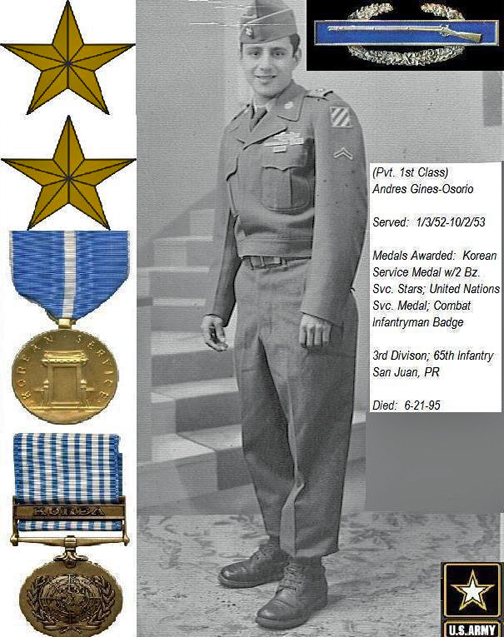
PFC Andres Gines Osorio
_________________________________________________________________________________________________
Sept. 28, 2000
Los Angeles Times Horacio "Rivets" Rivero, the Navy's first four-star admiral of Latino descent and the U.S. ambassador to Spain during the waning years of Francisco Franco's regime, has died. He was 90. Rivero died Sunday at his home in Coronado, Calif. A fourth star was pinned on Rivero's shoulder board in 1964, making him the first Latino to reach that rank. The first Latino admiral in the U.S. Navy was David G. Farragut, who uttered the immortal line, "Damn the torpedoes! Full speed ahead!" Farragut, the son of an immigrant from Spain, became an admiral in 1866. Growing up surrounded by water in his native Puerto Rico, Rivero always longed to go into the Navy. He won an appointment to the U.S. Naval Academy in 1927. Graduating in 1931,
third in his class of 441, Rivero became a specialist in ordnance engineering and, later, nuclear weapons. During World War II, he was a gunnery officer aboard the cruisers USS San Juan and USS Pittsburgh in the Pacific theater, earning a ! Bronze Star. In the Korean War, he commanded the amphibious transport USS Noble. By the time of the Cuban missile crisis in October 1962, he was commander of amphibious forces for the Atlantic Fleet. As a nuclear weapons expert, Rivero was privy to the Manhattan Project. After the war, he worked on atomic bomb tests on the Pacific islands of Bikini and Eniwetok. From 1961 to 1968, Rivero was vice chief of naval operations, the Navy's second-ranking post. He spent his last four years in uniform as commander of Allied Forces in Southern Europe for NATO. He was later appointed U.S. ambassador to Spain, and served for two years. In retirement, Rivero served as an adviser to the chief of naval operations, the Naval Academy, and the Naval War College.
10/02/2000
Benigno Carreras, 72, of Bethlehem, died Saturday, Sept. 30, in the Visiting Nurses Association Hospice of St. Luke's Hospital, Fountain Hill. He was the husband of Josephine (Czar) Carreras.
He was a logistics coordinator at the Lehigh Valley Postal Service facility before retiring in 1988.
He was a graduate of the New York Institute of Radio and Television. Born in Honolulu, Hawaii, he was a son of the late Benigno and Alice (Galindo) Carreras. He was a member of Notre Dame of Bethlehem Catholic Church. He was an Army veteran of the Korean War and was awarded the Purple Heart. He was a member of the Bethlehem area Men Of Retirement Age Club and the Hellertown American Legion Post 397. Survivors: Wife; sons, Steven of Florence, S.C., Benigno of Commack, N.Y., Kenneth; daughters, Cathleen Baker of Glenside, Montgomery County, Cynthia Perez of Bethlehem, Sonia Rivera of Ridgefield, N.J.; brothers, John of Orlando, Fla., Peter of
Mission Viejo, Calif.; sisters, Anna Mercado of West Hempstead, N.Y., Eugenia Diaz; 13 grandchildren. Mass: 10 a.m. Wednesday in the church. Call 7-9 p.m. Tuesday and 8:45-9:30 a.m. Wednesday, both in the Snyder-Hinkle Funeral Home, 527 Center St., Bethlehem.
Contributions: VNA Hospice.
10/12/2000
San Antonio Express-News
Mr. Willie Robledo Salazar, born July 17, 1931, went to be with Lord on Wednesday, October 11, 2000 at the age of 69. Willie Salazar served in the U.S. Army for two years. He was a veteran of the Korean War, an active citizen of his community, and the President of the Palm Heights Normyle Little League Baseball. He was employed at Alamo Heights High School for over10 years where he retired. He was a devoted husband and very supportive father, he always was there to lend a helping hand to those in need. He is survived by his wife of 48 years, Romanita G. Salazar; children, Willie Salazar Jr., Wilbert Salazar, Roland Salazar, Robert Salazar, Terry S. Arguello, Juan Salazar, Rudy Salazar, Rick Salazar and Ray Salazar; sisters, Vidala S. Markovic and Lina Salazar; 22 Grandchildren and five great-grandchildren; eight daughters-in-law and one son-in-law; aunt, Carmen Robledo. A Rosary will be recited Friday, 7:00 P.M. at the Trevino Funeral Home. Procession will depart Saturday, 10:00 A.M. for a 10:30 A.M. Mass at Our Lady of Guadalupe Catholic Church. Interment will follow in San Fernando Cemetery No. 2 under the
direction of Trevino Funeral Home.
GARCIA, JOHN MORGAN, 73, of St. Petersburg, formerly of Tampa, died Friday (Oct. 13, 2000) at St. Petersburg General Hospital. He came here 67 years ago from his native Tampa. He was a graduate of St. Petersburg High School and was part of the first male class to attend Florida State University. He was a Navy veteran of World War II and the Korean War. He worked for
several electronics firms, including Tipton's TV & Electronics, before opening Garcia TV Sales and Service in St. Petersburg in 1960. He sponsored numerous Little League baseball teams and enjoyed camping with his family. He was an electronics instructor at Pinellas Vocational Technical Institute beginning in the mid-70s, retiring in 1989. He was editor of the Printed Board, a newsletter of the Television Service Dealers Association, and was president of the South Pinellas County Retired Educators Association. He and his wife received the award for Volunteers of 1999-2000 from the association. He was a delegate to the state and national conventions of the National Education Association for more than 20 years. He was a model train hobbyist. He was a
member of St. Mark's United Methodist Church. Survivors include his wife, Joyce; three sons, Richard, St. Petersburg, John Jr., Cool, Calif., and Robert, Glen Cove, N.Y.; a daughter, Lisa Gussler, St. Petersburg; a sister, Elsie May, Palm Harbor; and six grandchildren. Anderson-McQueen Funeral Homes & Cremation Tribute Center-Bobbitt Chapel, St. Petersburg.
Source: Tampa Tribune ( Tuesday, October 17, 2000 )
MERCADO, James, 76, of Tampa, died Monday at St. Joseph's Hospital. Survived by his wife, Norma Mercado, four sons, James Mercado, Jr., Shermansdale, PA., Manuel E. Mercado, Tampa, Jody F. Mercado, Harrisburg, PA. and Remy Mercado, Tampa, 7 brothers, 4 sisters, 6 grandchildren and 1 great grandchildren. Born in Rincon, Puerto Rico, Mr. Mercado had been a resident of Tampa since 1969. He was a veteran of the US Army during WWII and was a general manger of a merchandise company. Funeral services will be held at 2:00 PM Friday in the funeral home chapel, with Pastor Kent Riner of Peninsular Christian Church officiating. Interment will follow in Garden of Memories. The family will receive friends from 6:00-8:00 PM Thursday at the funeral home. In lieu of flowers please make contributions to a charity of your choice.
Source: Star Ledger ( Friday, October 20, 2000 )
Luis Rodriguez, 87, of Lincoln Park died yesterday at home. Arrangements are by the Keri Memorial Funeral Home, Lincoln Park. Mr. Rodriguez was a draftsman at Howard, Needles, Tamman and Bergendorf Engineering, Fairfield, for 40 years before retiring two years ago.
He served in the Navy during World War II in the Seabees. Born in Naguabo, Puerto Rico, Mr. Rodriguez lived in New York City before moving to Lincoln Park in 1964. Surviving are his wife, Lena; a son, Jose; a daughter, Mrs. Yvonne Calderon; a brother, Efrain; a sister, Mrs. Carlota DeArteaga; seven grandchildren and eight great-grandchildren.
Source: Star Ledger ( Friday, October 20, 2000 )
Washington Post, Friday, December 29, 2000
Ramon Semidey-Soto
Ramon Semidey-Soto once told his brother that if he had to live his life over, he wouldn't change a thing. Twenty-eight years in the U.S. Army as a combat engineer, serving in World War II, the Korean War and three tours in Vietnam. Twenty-two years as a custodian at the Episcopal seminary and a church in Alexandria after his military career. His brief 1950s courtship of Camelia, the pretty girl who lived across the street from his mother in Mayaguez, Puerto Rico, and the couple's sudden decision to marry when Ramon was on leave in 1955. Their nine children, plus "strays" he often invited home -- mostly young Puerto Rican soldiers at Fort Belvoir, homesick for homemade rice and beans. A fierce devotion to family: Any party that did not include the kids was not for him. His old-fashioned ways: no dating or makeup for his daughters.
His ancestral pride: Every year, the family attended the National Puerto Rican Day Parade in New York City. His corny humor: "I! 'm full," one of the kids might say at dinner. "Glad to meet you 'Full,' " he would reply. "I'm Ramon." "He was a happy person," his brother, Jose, summed up.
Ramon left school after eighth grade to help support his family. He cut sugar cane, picked coffee beans, worked as a carpenter's helper and clerked in a food store. When the Army got its hands on him in May 1942, he was 20 years old and weighed 111 pounds. He sent his Army paychecks home to his mother. After his 1945 discharge, he took up cabinet-making. But that changed in 1951, when his brother Pedro was killed in Korea. "It made him angry," recalled Jose. "He felt responsible because . . . he thought he was supposed to be there." Over their grieving mother's objections, Ramon reenlisted, making the Army his career. He eventually obtained his high school equivalency diploma, completed various military training courses and worked his way up the ranks to sergeant first class. In 1968, the family moved to Alexandria after Ramon got a teaching position at Fort Belvoir's combat engineering school. He retired at age 55 with a dozen medals and citations. Not one to sit around, Ramon took a custodial job at Virginia Theological Seminary and later became sexton at Episcopal Church of the Resurrection, both in Alexandria.
"He was wonderful to be around. And he did his job better than anybody should have a right to expect," said the Rev. James Green, the church's retired rector. "I don't think he would have recognized the word 'menial.' " Ramon's daughter Carmen Bishop said her father "was afraid to retire, because he thought he would die." He finally did quit, though, in 1995. Then 74, he and Camelia began traveling. But just two years later, his health began to fail. First it was cataracts, then cancer of the prostate and colon. He died at Walter Reed Army Medical Center on Jan. 13. He was 78. For the wake, his family displayed his Army medals and draped his casket with the American flag. Their request for a military funeral was denied, the mortuary was told, because the burial was Jan. 17, a federal holiday. The news disappointed, even angered, his widow and children. "That's something he would have liked," said Carmen. Besides, added daughter Elvira Urrutia, "He deserved it."
-- Sylvia Moreno
Published in the Home News Tribune 1/5/01
Michael J. Cordero Sr., 79, of Woodbridge died Wednesday at home. He was born in Brooklyn, N.Y., and had lived in Woodbridge the past 40 years. He was employed for 33 years as a tractor-trailer operator with Bil-Kay's Express in Elizabeth before retiring in 1984. He was a member of Teamsters Union Local 407 in Newark, and Teamsters Union Local 807 in Elizabeth. He was an Army veteran of World War II. He served with the 82nd Airborne and the 106th Airborne units as an infantry soldier as well as a tank-destroyer crew chief, and in the 706th Tanker Division under General George Patton. He participated in battles at the Rhineland Bridge, and in Normandy and Bastogne, including the Battle of the Bulge. He was a communicant of St. James R.C. Church of Woodbridge. He is survived by his wife, the former Nena Cassano; three sons, Michael Jr. of Sparta, N.J., Gary of Carteret and Ronald Sr. of Edison; a sister, Rose Catalana of Howard Beach, N.Y.; a brother, Frank Cordero of Clearwater, Fla., and five grandchildren, Ronald Jr., Brian, Thomas, Jennifer and Jaclyn. The funeral will be held at 11 a.m. Saturday at Leon J. Gerity Funeral Home, 411 Amboy Ave., Woodbridge, followed by an 11:30 a.m. Mass at St. James R.C. Church in Woodbridge. Entombment will follow at St. James Mausoleum, Woodbridge. Visiting will be from 2-4 and 7-9 p.m. today at the funeral home. Donations in his memory can be made to St. James R.C. Church of Woodbridge.
Colonel (Retired) Howard Bertolet St. Clair
West Point Class of 1939
(Cadet Number 11619)
Colonel (Retired) Howard Bertolet St. Clair passed away of natural causes on July 2, 2003 in Charlotte, North Carolina. He was 87 years old. He was born on June 11, 1916 in War, West Virginia to Will and Ethel Dixon St. Clair. His military career spanned thirty years and included service in World War II, the Korean War, and the Vietnam War.
Howard St. Clair entered the United States Military Academy at West Point, New York in 1935 after one year at Marshal College in West Virginia. According to a classmate, St. Clair “ran afoul of the academics Plebe year, fought the usual battle, won, and hasn't worried since about the Academic Department.” A natural athlete “Saint” devoted himself to track and cross country and was a pistol sharpshooter. He also taught Sunday school for three years. He graduated on June 12, 1939, as the clouds of war were gathering over Europe. The graduation speaker was President Franklin Delano Roosevelt. St. Clair served as the G2 (Intelligence Officer) of the 99th Infantry Division during World War II in the European Theater of Operations. Arriving in Le Havre, France on November 3, 1944, the division saw bitter fighting during the Battle of the Bulge and at the Ruhr pocket and suffered some 6,100 battle casualties, including almost 1,100 killed in action. After the war he served with the 15th Armored Division and then in the War Department General Staff. In 1949 he assumed command of the 1st Battalion, 65th Infantry Regiment, stationed at Losey Field in Puerto Rico. The unit was the Regular Army’s only all-Hispanic infantry regiment. St. Clair’s battalion played a major role in the 65th Infantry’s stubborn defense of Vieques Island during the Puerto Rico Exercises (PORTREX) of 1950. PORTREX was the American military’s largest joint, amphibious, and airborne maneuvers in history. The regiment’s defense of the island against the soldiers of the 3d Infantry Division and a battalion of paratroopers from the Army’s elite 82d Airborne Division received wide publicity and garnered the praises of the nation’s senior civilian and military leadership, which was instrumental in the decision to send the 65th Infantry to Korea following the outbreak of war there in June 1950. Deploying in August aboard the United States Troop Ship Marine Lynx, St. Clair’s 1st Battalion arrived in Korea in September and spearheaded the regiment’s drive north as part of first the 2nd Infantry and then the 25th Infantry Divisions. In October the 65th Infantry finally joined the 3d Infantry Division, the regiment’s parent unit for the duration of the war. Colonel St. Clair’s raw courage in combat served his battalion well. In November 1950, after one of his companies had been attacked and surrounded by Chinese Communist Forces, he fought his way to the isolated unit and, with utter disregard for his own safety, organized a defense under fire, ensuring the survival of his men pending the arrival of reinforcements. And during the Spring of 1951, after elements of his battalion were surprised and almost overwhelmed by a large enemy force, he again moved to the forefront of the fighting, crossing bullet-swept terrain many times to direct a successful defense and call in supporting fires. While his men repulsed an attacking Chinese regiment, inflicting staggering losses on the enemy, Colonel St. Clair moved “fearlessly about the embattled perimeter urging his battle weary troops to stand firm.” While in command of the 1st Battalion in Korea, Colonel St. Clair was decorated with two Silver Stars, a Bronze Star Medal, and an Air Medal. His performance had been noted by General Matthew B. Ridgway, the Eighth Army Commander, who personally selected St. Clair for regimental command later in his career. Upon the completion of his tour of duty as a battalion commander, Colonel St. Clair was assigned to Headquarters, U.S. Army Field Forces at Fort Monroe, Virginia. This was followed by a tour with the National Security Agency in Maryland from 1955 to 1957. In 1957 he took command of the 28th Infantry Regiment, then stationed in Germany. At the time the regiment had one Battle Group attached to the 8th Infantry Division and a second attached to the 1st Infantry Division. Colonel St. Clair went on to serve with Special Operations Forces in Europe and in 1960 he became the VII Corps G3 (Operations Officer). From 1962 to 1965 he served on the Staff and Faculty of the Infantry School at Fort Benning, Georgia. This was followed by a tour as the Republic of Vietnam’s I Corps Senior U.S. Adviser, responsible for the U.S. military advisory effort in the country’s five northern provinces. In 1966 Colonel St. Clair joined the staff of U.S. Strike Command at MacDill Air Force Base in Florida. He retired in 1969 after three wars and thirty years of distinguished service.
Colonel St. Clair’s awards and decorations include the Combat Infantry Badge with Star and Wreath, two Silver Star and two Bronze Star Medals for valor, the Legion of Merit, six Air Medals, the Joint Service Commendation Medal, and three Commendation Medals.
Howard St. Clair spent most of his retirement in Columbia, SC. He was devoted to his children, West Point, the Army, and his home and family in West Virginia. Those close to him knew that his gruff demeanor belied a sensitive and caring soul. He is survived by his brother Sam, children Diane, Michael, and Steven, and his grandchildren Michael, Jennifer, Stephanie, Daniel, Nicholas, and Christopher – to whom he was the Grand Colonel. His devotion to his country, sense of duty and honor, and love of friends and family will always be with us.
A memorial service with full military honors will be held on Friday, September 12, 2003 at Arlington National Cemetery in Washington D.C.
Colonel Gilberto Villahermosa
Cpl. Ramiro Rivera Martinez. died on February 27, 2004. He fought in the Korean War from 1951-53 with the 65th Inf. Regt, M Company. Photographs of Cpl. Ramiro Rivera Martinez can be seen at
http://www.valerosos.com/65th-infantry-regiment2/65th-infantry-regiment-46-58/index.html
________________________________________________________________________________________________________________
Ruben Santiago Cabrera died on April 20, 2004. PFC Ruben Santiago Cabrera served with Company D, 65th Infantry Regiment during the Korean War. He was a recipient of the Bronze Star
for Valor on December 22, 1950. Ruben Santiago Cabrera was also a veteran of the Vietnam War. I was informed of his passing by his daughter Hilda Eickenhorst.
______________________________________________________________________________________________________________
My Father, SSG Nestor D. Ramirez, a career soldier and a native of Maricao, PR served with the 65th Inf. Regt.(H Co.)during WW2 and Korea. Dad passed away on Nov.2, 2004. I am very proud to be his son. He is buried with my mother, Irma Ramirez, at Arlington National Cemetery. Thank you for honoring all 65th veterans!!
COL Nestor D. Ramirez, Jr., JAGC-USAR
____________________________________________________________________________________________
“Mario E. Villamarzo, a 33 year World War II US Army veteran and father of 4 died on Tuesday, 04 January 2005. A resident of Sierra Vista for the past 8 years, he was born in the family home in Ponce, PR, on 24 January 1916. One of 10 children of a Spanish immigrant father Jos� Villamarzo Lled�n and a Puerto Rican mother Am�rica L�pez Pag�n, he was 88 years old. He died at home with his eldest daughter, Gloria. In the beginning of his long Army career he served with the Puerto Rico Army National Guard in the early 1940s, later during WWII as a member of the 65th Infantry Regiment he served in North Africa, France and ultimately in Germany as part of the Army of Occupation. After the War he served at various posts in the Panama Canal Zone, the Continental United States and in West Germany. Captain Mario E. Villamarzo retired in January 1971. I was informed of his passing by his daughter Gloria Dueltgen.”
Letters from Captain Mario E. Villamarzo to his daughter Gloria by v-mail. At the time Captain Mario E. Villamarzo was in Europe with the 65th, Gloria was 2 years old. V, or Victory mail, was the process of microfilming letters written by soldiers during W.W. II. For additional information about the process, which was an English idea to save cargo space when delivering mail, visit the National Postal Museum, a Smithsonian Institution museum, located in the old Post Office building next to Union Station in Washington, D.C., the link to their web site is - National Postal Museum
________________________________________________________________________________________________________
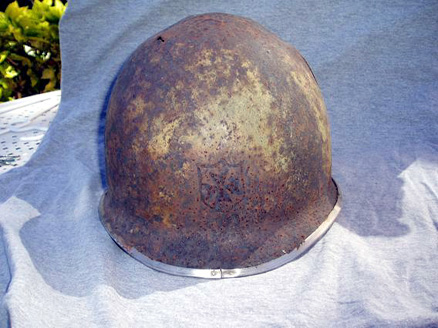
These two photos of a combat helmet of W.W.II vintage was submitted to this site by Jean-Loup Gassend. Below is a short paragraph explaining how the helmet came into his possession.
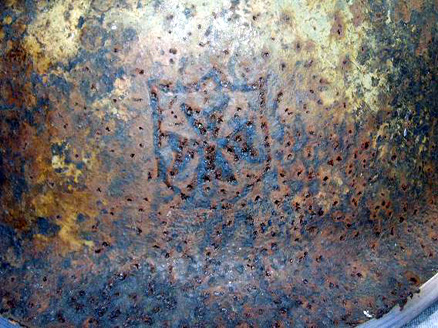
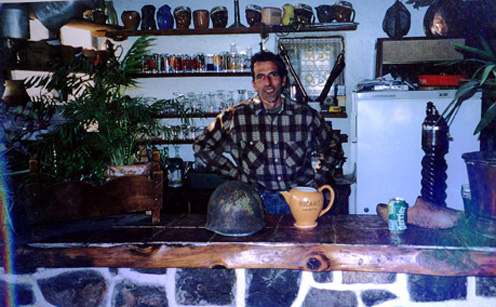
In 2003 I decided to go and visit Col de Bross, near Sospel, a mountain pass in southern France that the 517th parachutist regimental combat team had trouble capturing in September 1944. I went into the local bar to ask the owners if ever people ever found any relics on the battle field. It just happened to be that the owner had recently found this helmet stuck in the branches of a tree way down in a lost valley, near Peira Cava, about 20 km away from col de Bross. He accepted to exchange the helmet for a "Pastis" (a famous alcohol from Provence) pitcher, that he then added to his pitcher collection. The helmet has remnants of camouflage on it, particularly visible on the front left side as a black streak. That, and the fact it was discovered in Peira Cava made it very probable that this was a helmet from the 517th prct. But there was also a Malta cross and what appeared to be the number 69 engraved on the front of the helmet, the meaning of which remained a mystery to me. It was only in 2005, with precious help from an internet forum, that I discovered that the Malta cross was the insignia of the Puerto Rican volunteer 65th Infantry regiment, who arrived in southern France in September 1944, and were then sent to... Peira Cava. All the chips fell into place. It is surprising to see that there is camouflage paint on what is only an Infantry helmet. The soldier who wore this helmet must have been proud to be a Puerto Rican volunteer, since he took time to engrave the units insignia into the paint, which was not common practice in the US army.
Jean-Loup Gassend_____________________________________________________________________________________________________________________________
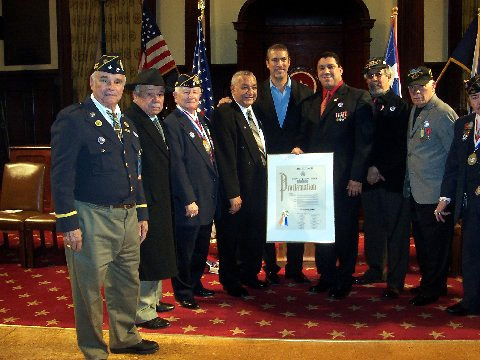
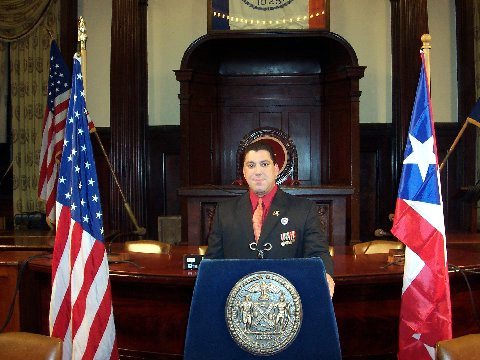
NOV 3, 2005, NYC CITY HALL, PROCLAMATION PRESENTED BY THE CITY COUNCIL
TO THE 65TH HONOR TASK FORCE, 65TH VETERANS, NEW YORK STATE ASSEMBLYMAN,
ADAM CLAYTON POWELL IV, CHAIRMAN 65TH HONOR TASK FORCE, ANTHONY MELE'.
CHAIRMAN 65TH HONOR TASK FORCE, ANTHONY MELE'
NOV. 7. 2005, HONOR Y VALOR, PRESENTATION AT HARVARD UNIVERSITY,
BOSTON, MASSSPEAKERS, ANTHONY MELE, CHAIRMAN, 65TH HONOR TASK
FORCE VIVIEAN ROMAN, LATINA WOMEN IN THE MILITARY, TONY MOLINA,
FIRST LATINO PURPLE HEART RECIPIENT OF THE VIETNAM WAR
_____________________________________________________________________________________________________________________Carlos Manuel Gonzalez Cottes
Nov. 20, 1927 - April 11, 2006
Carlos Manuel Gonzalez Cottes, 78, of Sierra Vista, Ariz, passed away Tuesday, April 11, 2006, at the Sierra Vista Regional Health Center. He had been an area resident for seven years.
Carlos was born Nov. 20, 1927, in Canovanas, Puerto Rico, to Gerardo and Maria Cottes Gonzalez. Carlos served in the U.S. Army, where he retired after 20 years, in 1967 as a Staff Sergeant. He was very proud to serve his country during World War II, Korea and Vietnam. Carlos loved to watch CNN. His greatest pleasure was listening to music and dancing or telling jokes. Toward the end of his life, what he enjoyed the most was collecting pictures of his family, especially his grandkids and great grandkids.
Carlos is survived by his wife of 58years, Hilda E. Gonzalez, seven children; Raquel, Nydia, Elena, Carlos, Manuel, Myriam and Clara Gonzalez, his sister, Amalia Gonzalez, ten grandchildren; Manuel Jr., Marie, David, Nicholas, Nelson, Tanisha, Raquel, Charles, Bianca and Daniela, and four great grandchildren; Gabriel, Taina, Sophia and JJ.
A time of visitation will be held from 10 a.m. to noon on Thursday, April 13, 2006, at the Hatfield Funeral Home, 830 S. Highway 92, Sierra Vista. Funeral services will begin at noon. Interment with military honors will be held at 10 a.m. on Friday, April 14, 2006, at the Southern Arizona Veterans Memorial Cemetery.
Arrangements are by the Hatfield Funeral Home.
Sierra Vista Herald - Editorial, Advertising, Business and Circulation offices: 102 Fab Avenue, Sierra Vista AZ 85635 and 12 Main Street, Bisbee AZ 85603
-------------------------------------------------------------------------------------------------------------------------------------------------------
First Sergeant Bobby Mendez
Sept 18, 1967 — April 27, 2006
First Sgt. Bobby Mendez, 38, was killed in Baghdad on Thursday, April 27, 2006, while serving with the 4th Infantry Division out of Fort Hood, Texas.
Bobby was born Sept. 18, 1967, in Brooklyn, N.Y., to Gladys Arce and Amado Mendez. He served in the U.S. Army for 19 years.
Bobby married Jennifer on Oct. 16, 1989, in Brooklyn, N.Y.
After traveling extensively with the Army, including a tour in Desert Storm and Korea, the Mendez family transferred to Fort Huachuca, Ariz., in June 1997 and have established a home in Arizona ever since.
While stationed at Fort Huachuca, Bobby was an instructor at the NCO Academy and was active in the community by coaching little league baseball and soccer. And, staying true to his roots, he was an avid Yankees and Giants fan.
Bobby was assigned to 4th ID in Fort Hood, Texas, in January 2002 and deployed to Iraq in April 2003. After safely returning to Fort Hood in March 2004, Bobby was again deployed to Operation Iraqi Freedom in November 2005 where he was killed when his convoy intercepted an improvised explosive device (IED).
Bobby is survived by his wife of 16 years, Jennifer; three children, Thyiena, 13, Quentin, 12 and Chyanne, 7; parents Gladys Arce and Amado Mendez (Noemi); sisters Ivette and Joan; brothers Steven (Theresa) and New York Police Officer Richard (Miriam); nieces Melissa, Victoria and Daphne and nephews Casey and James.
Bobby died doing what he loved. He was a soldier to his core. He served his country with pride and honor and was the personification of the Army Core Values. Bobby was funny, loyal and extremely intelligent. His family and friends are very proud of him and his service to his country. No one was more professional than First Sgt. Mendez. He was and will always be a non-commissioned officer, a leader of soldiers. He had so much life left to live, this is a monumental loss to the family and the US Army and he will be greatly missed.
The viewing will be held Sunday, May 7, 2006, from 4 to 7 p.m. at Hatfield Funeral Home, 830 S. Highway 92. Funeral Services will be held May 8, 2006, at 9 a.m. at Main Post Chapel on Fort Huachuca, Ariz. Military honors will follow at Post Cemetery on Fort Huachuca.
Arrangements are with Hatfield Funeral Home.____________________________________________________________________________________________________________________________
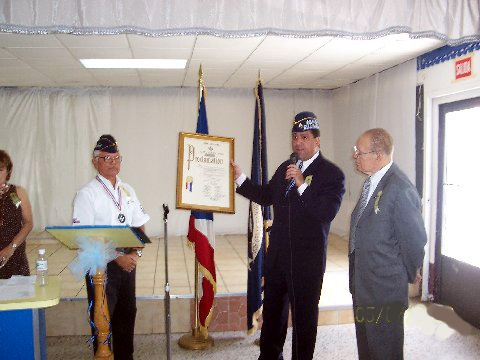
Francisco Alicea (President, 65th Retired Association) receives a
Proclamation from Anthony Mele (Chairman, 65th Honor Task Force)
signed by the NYC Council on the occasion of their 100th Anniversary.
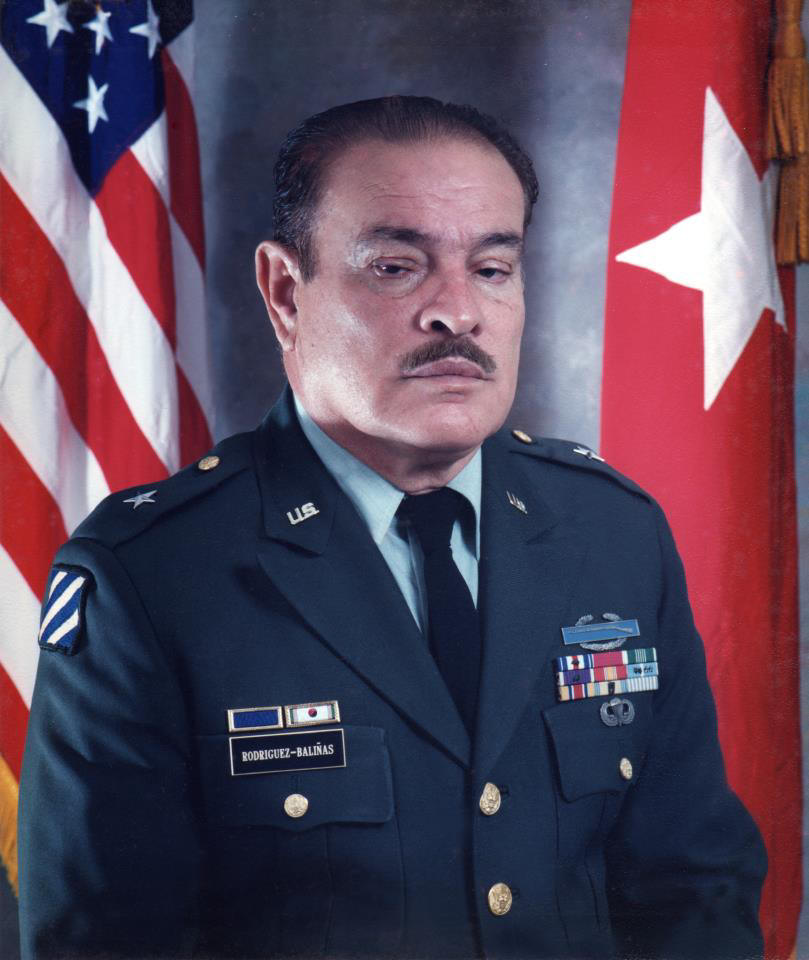
BG Antonio Rodriquez-Balinas, highly decorated 65th Veteran looks on.
May 07, 2006
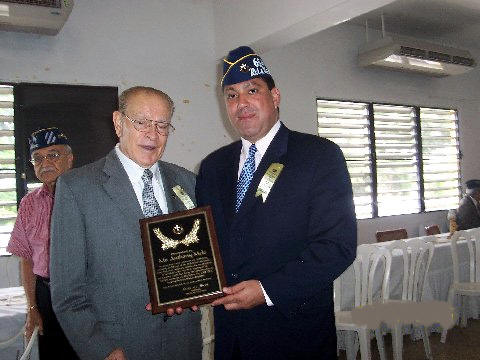
BG Antonio Rodriquez-Balinas awards Mr. Anthony Mele, Chairman 65th Honor Task
Force with a plaque in recognition of his leadership and dedication for organizingceremonies honoring the 65th at Arlington National Cemetery, El Morro, San Juan,
Puerto Rico and Fort Logan National Cemetery, during the 50th Anniversary of the
Korean War. May 7, 2006
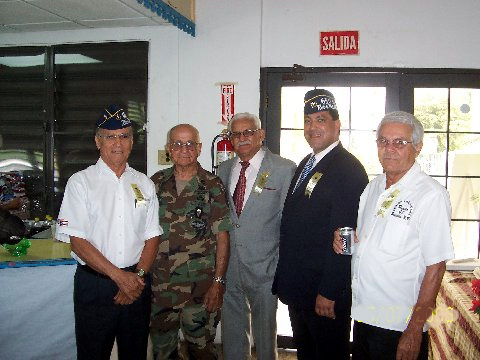
Members of the 65th Retired Association in Puerto Rico. Jump Master Velgarra
68 years old (camoflouge) just returned from a parachute jump in St. Thomas.
______________________________________________________________________________________________________
October 13, 2006
Major (Ret.) Luis Raul Rodriguez passed away this October 11, 2006, he is survived by his wife Nereida, two daughters, and a son. Major (Ret.) Luis Raul Rodriguez served with the 65th Infantry Regiment in Company F during the Korean War.
The viewing will be held today at the Hillcrest Memorial Park Cemetery today October 13, 2006.Hillcrest Memorial Park Cemetery6411 Parker AvenueWest Palm Beach, FL 33405(561) 582-4131This information was provided by Ruben R. Laureano Diaz.
______________________________________________________________________________________________________________________
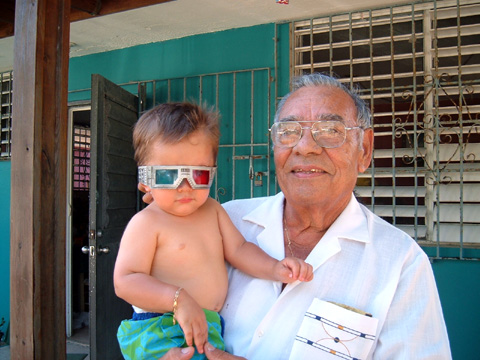
This is a recent photograph of Bronze Star recipient Angel D. Normandia Cintron with his great grandson Jose Andres. The photograph was taken at Puerto Nuevo Beach, Vega Baja. A few days ago one of his grandsons, Juan B. Cosme Normandia, was ascended to lieutenant colonel, his family is very proud of him too. Angel D. Normandia Cintron will be 80 years on November 5, 2006. He lives in Miraflores, Bayam�n. He is still strong and active, as you can see in the photo. To see Angel D. Normandia Cintron’s Bronze Star citation click on the following link. The photograph and information was provided to this site by his son Angel D. Normandia Ayala.
_______________________________________________________________________________________________________________________
Thursday, May 24, 2007
65th U.S. Army Regiment is remembered
Puerto Rican unit in Korean War
By Priyanka Dayal TELEGRAM & GAZETTE STAFF
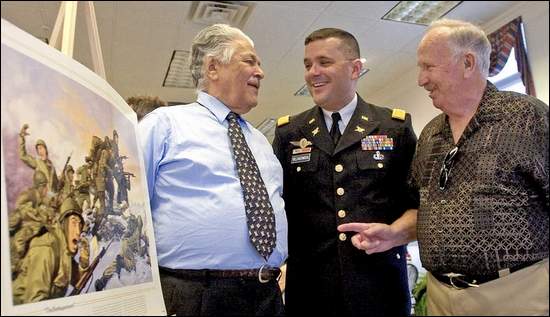
At a reception yesterday at the U.S. Presidential Museum, the
Rev. Jose S. Perez of Worcester, from left, Col. Gilbert Villahermosa
and veteran Myles E. Geer talk as they look over a painting,
“The Borinqueneers,” which depicts the Puerto Rican 65th Regiment
fighting during the Korean War. (T&G Staff/STEVE LANAVA)
WORCESTER— Scanning the faded black-and-white prints sitting on the table, Myles E. Geer, a veteran of World War II and the Korean War, paused and pointed to a photo of one soldier.
“He was killed,” he said.
Mr. Geer scanned the photos again. “But we had fun, too,” he said, pointing to two men wrestling with a football near a leafy tree.Mr. Geer served in the Puerto Rican 65th U.S. Army Infantry Regiment, an all-volunteer unit that was among the biggest, best trained and most successful regiments to fight in the Korean War.
While he was in Korea in 1953, he took many photographs. Yesterday, his photographs were seen by dozens of people who came to honor the regiment in anticipation of the completion this year of the Korean War Memorial on Worcester Central Boulevard.
“It’s about time the 65th regiment got recognized for what they did,” said Mr. Geer, who lives in Yukon, Mo. “The boys of the 65th may be the best that the Army ever had. … If there was danger, they would be by your side all the time. There was never a task that was too hard for them.”
The 65th Regiment began as the Puerto Rico Battalion of Volunteer Infantry in 1899. It 1908, the unit became part of the U.S. Army. Its soldiers, who made up one of very few ethnically based regiments in the Army, have fought in World War I, World War II and the Korean War.
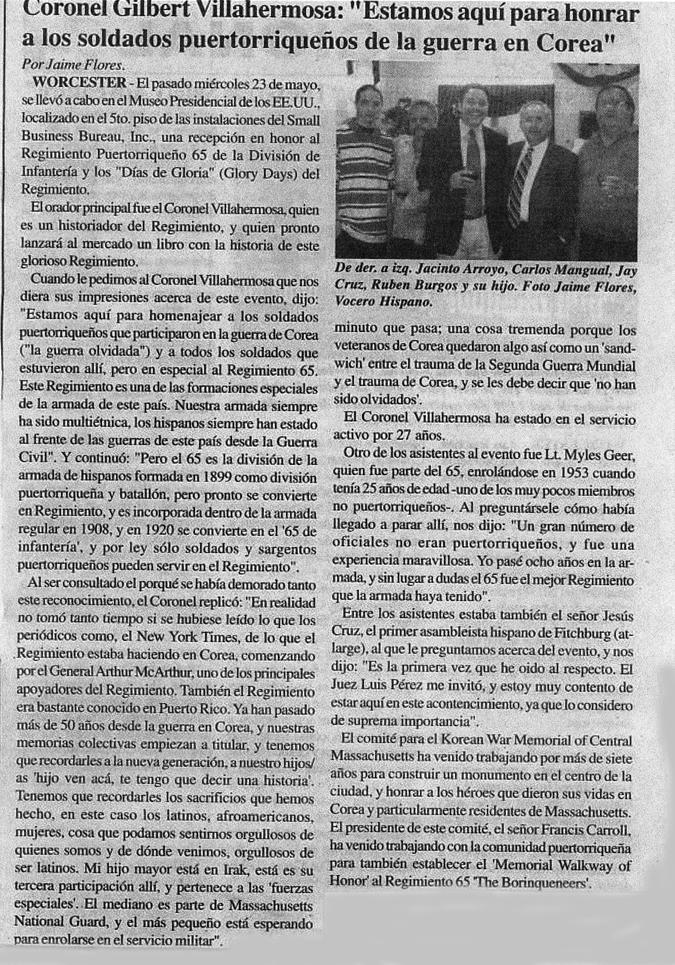
To Col. Gilbert Villahermosa, inspector general of the Massachusetts Army National Guard, the history of the 65th Regiment reflects America. The colonel, who has spent 27 years in the Army in combat and later as a historian, has written a book about the regiment’s service in Korea in the early 1950s.
“Our Army has always been tremendously ethnically diverse,” he said. “(American) history is more than just the history of whites. It’s the history of the Irish and the Italians. It’s been the history of Puerto Ricans … African Americans … Asians.”
Col. Villahermosa’s interest in the 65th is natural — his father served in the regiment. He called his father “an indigenous peasant” who lived the American dream and succeeded.
“The (65th) Regiment fought brilliantly,” he said, and their dramatic and heroic story should be told.
The Rev. Jose S. Perez of Worcester, who attended yesterday’s reception, also served in the 65th Regiment. He had few words to say. He was just thankful.
“This means a lot,” Rev. Perez said. “It means a lot of people remember the 65th.”
He recalled his days in Korea as cold and long. “We had no rest,” he said. And when soldiers did sleep, they were often burrowed in foxholes.
Because it was sandwiched between World War II and the Vietnam war, two seismic conflicts that defined the 20th century, the Korean War is often called “The Forgotten War.” The Korean War Memorial was erected to ensure that veterans and soldiers killed in Korea are not forgotten.
The first part of the memorial, the Wall of Honor, is complete. The Walkway of Honor, which will include a section devoted to the 65th Regiment, will be completed before the dedication ceremony planned for Oct. 20. Organizers are hoping more than 1,500 people will attend.
A documentary about the 65th Regiment is scheduled to air on PBS on Aug. 1.
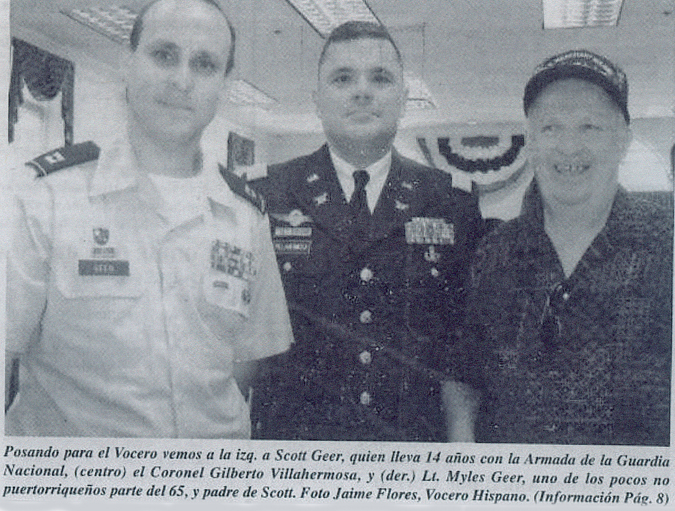
Scott W. Geer, a captain in the Massachusetts Army National Guard and son of the veteran Mr. Geer, said yesterday’s event and the Korean War memorial will help people learn about the 65th Regiment’s service.
“When you talk about war, when you talk about veterans, usually Korea is the last one to come up,” he said. “I think that’s why he talks more about it.”
The older Mr. Geer’s military service had a profound impact on his son, who also enlisted in the armed services.
“I’m very proud of my father’s service,” the younger Mr. Geer said. “My dad’s my hero.”� 2007 Worcester Telegram & Gazette Corp.
_____________________________________________
_______________________________________________________________________________________________
Pvt2 Eufemio Santiago
Pvt.2 Eufemio Santiago - circa 1952
Pvt2 Eufemio Santiago served as a radioman in Company E, 65th Infantry Regiment in 1952. This photograph was submitted to this site by his proud son, David Santiago. Today July 11, 2007 Eufemio is 77 years young, we wish him a Happy Birthday.
______________________________________________________________________________________________
Corporal Cristobal Melendez Claudio
Cpl. Cristobal Melendez Claudio - circa 1950 - 1951
Sgt Cristobal Melendez Claudio and his wife
Josephine - Central Park - 1957
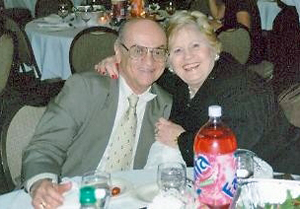
Cristobal Melendez with wife Josephine and granddaughters Maggie and Emilly
_______________________________________________________________
SFC Fernando Diaz
Recent photographs of retired Master Sergeant Fernando Diaz, Master Sergeant Fernando Diaz (retired) is a Silver Star recipient, Fernando received the Silver Star for valor while serving with the Headquarters and Headquarters Company of the 65th Infantry Regiment on Dec 18, 1950. To read the citation for SFC Fernando Diaz's Silver Star go to Silver Star. MSgt Fernando Diaz (retired) would like to contact former friends who served with him, to contact him write to Fernando Diaz, Box 728, Cidra, Puerto Rico 00739 or e-mail his son at [email protected] . His proud son Fernando Diaz Jr. who is a Vietnam Veteran and served with the 173rd Airborne submitted this information to this site.
Fernando Diaz and his wife
_______________________________________________________________________________
SFC James De Gruttola Retired
Sgt James De Gruttola (right) and Capt. Officer -
Circa early 1954
Sgt James De Gruttola's Korean War Memoirs
James De Gruttola was born on December 1, 1917, in New York City’s Bronx. Drafted into the Army at the beginning of World War II, he soon found himself in Britain, training and preparing to participate in thecoming Allied Invasion of Europe. Despite the dangers ahead, James found that he enjoyed the challenges of Army life.
On June 6, 1944, D-Day, James landed on Utah Beach in Normandy and contributed his best efforts to the success of the American Forces on that long historic day. He subsequently fought all across Europe, and was at the Battle of the Bulge when the Germans’ last great thrust was finally stopped near Bastogne.In the course of these epic events, James met and fell in love with Ren�e, a Belgian girl from Li�ge. After the war, he helped with the repatriation of our vehicles and equipment in Germany until he was eventually sent home and demobilized.
Back in the Bronx, James worked hard and saved his money until he had enough to return to Belgium and marry the girl he loved. After their marriage, James re-enlisted in the Army and managed initially to be assigned to graves registration duties in Belgium. In 1953, after a tour in the US, he was assigned to the 65th Infantry Regiment in Korea as a member of the first group of non- Puerto Ricans to be integrated into that famed regiment. James always considered the 65th as something special, and was proud to have served his country in it. After serving additional tours in the US and France, James retired from the Army in 1966. James De Gruttola died in Brussels on December 22, 2004 at the age of 87. His ashes and those of Ren�e were taken to Arlington Cemetery in October 2005 for his last “military posting”.
__________________________________________________________________________

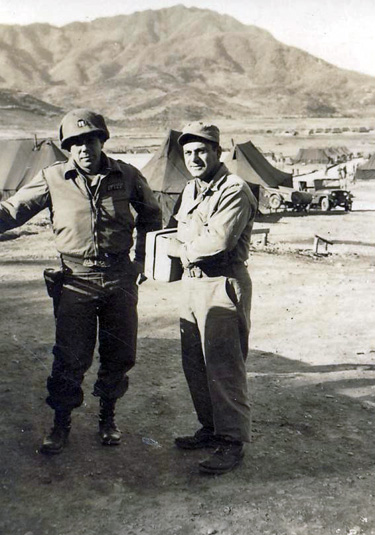
1LT Myrom Dushkin
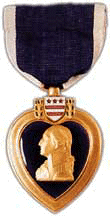
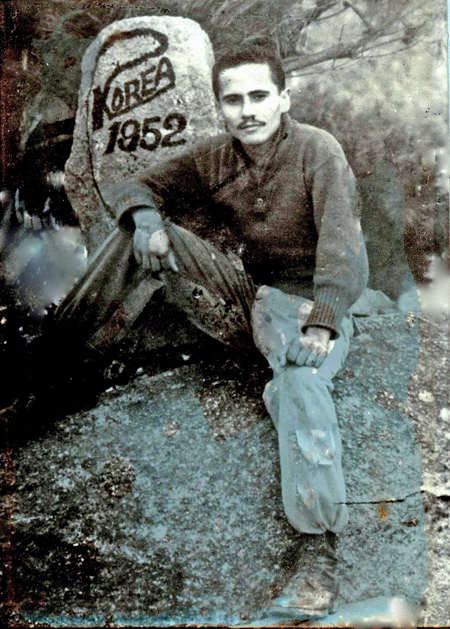
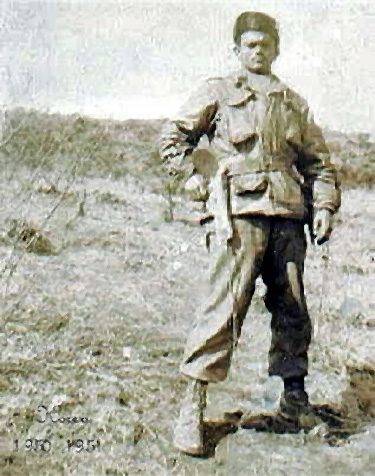
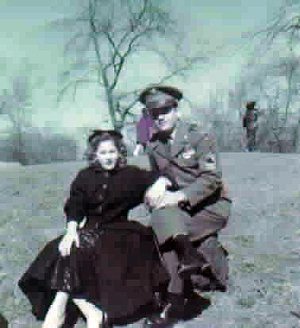
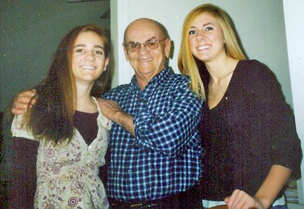
Silver Star recipient 1Lt. Myrom Dushkin passed away yesterday, 7 November, 2007, 1Lt.Myrom Dushkin served with the 65th Infantry Regiment in the Heavy Tank Company. On June 22, 1951 1Lt. Myrom Dushkin received the Silver Star for action on April 19, 1951. This page was notified of Myrom Dushkin's passing by his son Mark Dushkin.
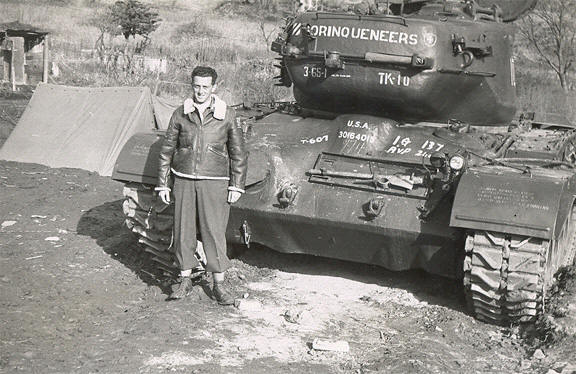
1Lt. Myrom Dushkin - circa 1951
__________________________________________________________________________________________________________________
PFC Miguel Montes Ortiz
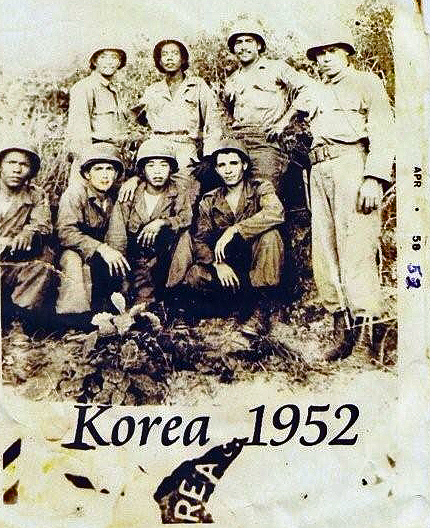
PFC Miguel Montes Ortiz (extreme right crouching down)
_______________________________________________________________________________________________________________________
La historia de un soldado
Lo que sigue es parte de las cosas importantes que me ocurrieron a m� en
Corea mientras que form� parte de los de la 65th Infanter�a, 3rd
Divisi�n, en la compa��a L al principio de sept. 1952. Mi primera
experiencia en batalla fue entre los morteros y el fuego de artiller�a
enemiga, alcanzamos un lugar en donde tuvimos que hacer trincheras delante
de la colina Kelly. Entre la colina Kelly y nuestra trinchera existi� lo qu�
era conocida como “tierra de nadie”. Nos fuimos all� para hacer patrulla de
reconocimiento, cada noche, encontrar�amos a patrullas enemigas y tendr�amos
que ocasionalmente enganchar en combate. Hab�a muchas patrullas mientras
estaba presente all�, m�s de veinte en una noche. La Tropa B estaba en las
trincheras enemigas en puesto avanzado de la colina Kelly' pero fue atacada
por el enemigo y muchos fueron tomados presos. Los otros que pod�an escapar
pasaron por nuestro O/P (compa��a L) y relataron c�mo fueron atacados por un
enemigo que excedi� en n�mero m�s que el del Puertorrique�o all�. Eso era
cuando la compa��a L tuvo que asumir el control. Pasado algunos d�as,
recibimos la orden para atacar al enemigo y para intentar tomar el puesto
avanzado de Kelly del enemigo. Era el 24 de septiembre de 1952 que golpeamos
las trincheras en la base de la monta�a, despu�s de que cruce el r�o bajo
ataque enemigo en la falda de la monta�a. La orden fue dada para perforar
con las bayonetas y para subir la monta�a. Era temprano por la ma�ana y
hab�a muchas nubes en el cielo y el fr�o se levant� encima de la monta�a.
Sin mucho problema fue hecho, pero cuando est�bamos en el centro de la
colina de Kelly, el enemigo sali� de los t�neles detr�s de nosotros y en
todos los lados nos rode� y tuvimos que abrir fuego y luchar hombro con
hombro con el enemigo usando nuestras bayonetas. Mientras que continuamos
yendo encima de la monta�a, una lluvia de balas (Bellgone) de una
ametralladora china peque�a, me hiri�. Una bala me alcanz� en la palma de mi
mano pero continu� hacia adelante y continuaron lanzando muchas granadas que
rodar�an abajo y estallar�an en todos los lados. Una de esas granadas,
estall� en mi pierna derecha, rompi� mi bota y las medias que ten�a puesto,
que eran tres pares. Aun cuando estuve lastimado tres veces, tuve que
continuar yendo para arriba, las heridas estaban calientes y frescas, as�
que no lastimaron mucho, casi alcanc� la tapa de la monta�a cerca de un
llano y nos atacaron otra vez con la artiller�a pesada. Ese momento, en el
cual nos contrataron a hombre servir combate con las bayonetas, un mortero
puls� que rompi� la culata de mi rifle y agarr� un pedazo de mi brazo que
parti� los nervios de ese brazo. El otro tir� francamente me golpe� en la
nalga izquierda. Los que estaban alrededor de m�, los hicieron saltar en
pedazos, mi teniente muri� con muchos de mis otros camaradas y tambi�n mucha
parte del enemigo. No ten�a mi rifle. Perd�a mucha sangre y tambi�n perd�a
el sentido. Me mord�a para mantenerme despierto; At� una media a mi brazo y
continu� rodando abajo de la monta�a. En la falda de la monta�a, no pod�a
cruzar el r�o pero en el otro lado un camarada que ten�a una ametralladora
colocada, gritaba a m�. Le dije que era Montes de la Tropa L; �l cruz� el
r�o y me trajo al otro lado. Mientras que �l me ayud� con mis heridas y bajo
un �rbol de Ceiba sin hojas, un mortero cay� y uno de las ramas peque�as lo
penetr� con una herida superficial en la parte m�s inferior de su cuerpo.
Aproximadamente 15 minutos, un helic�ptero de rescate lleg� y me movieron,
�se era el 24 de septiembre, yo perd� el conocimiento y despert� en Se�l,
Corea en un hospital el 29 de septiembre, ellos me pasaron m�s adelante a
Osaka, Jap�n. Muchas operaciones, muchos hospitales, pero agradezco a Dios
que estoy vivo para recordar las batallas que he encontrado. En una nota
final, quisiera indicar que en toda fe, mi compa��a y los soldados valientes
que los componen dieron a si mismo lo m�ximo para el pa�s y para la
libertad. Dimos todos con orgullo en el servicio del ej�rcito de los Estados
Unidos. Mucho Puertorrique�os murieron cuando le hicieron frente
valerosamente al enemigo y todas las heridas recibidas fueron confrontadas
por amor. �Que Dios bendiga los soldados valerosos de Borinqu�n!
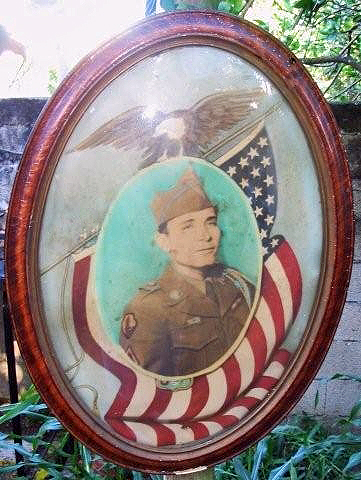
PFC Miguel Montes Ortiz
The
Story of a soldier
The following is part of important things that
occurred to me in Korea when I served with the 65th
Infantry, 3rd Division, in
Company L at the beginning of Sept. 1952. In my first experience in battle,
the Company was exposed to mortar and enemy artillery fire, we reached a
place where we had to make trenches in front of Kelly Hill. Between Kelly
Hill and our trenches existed what was known as “No Man's Land”. We left
there to make a reconnaissance patrol, every night, at times we would find
enemy patrols and would have to engage in combat. There were many night
patrols while I was present there, more than twenty. B Company was in the
enemy trenches at Kelly Hills’ Outpost but was attacked by the enemy and
many were taken prisoners. The others who were able to escape passed by our
O/P (Company L) and related how they were attacked by an enemy that
outnumbered the Puerto Ricans there. That was when Company L had to take
over. In a few days we received the order to attack the enemy and try to
take the Kelly Outpost from the enemy. It was on September 24, 1952 that we
hit the trenches in the base of the mountain, after crossing the river under
enemy attack in the skirt of the mountain. The order was given to "fix
bayonets" and climb the mountain. It was early in the morning and there was
many clouds in the sky and the cold rose up the mountain. Without much
problem, it was done, but when we were in the center of Kelly Hill, the
enemy came out of tunnels behind us and on all sides surrounded us and we
had to open fire and fight hand to hand with the enemy using our bayonets.
While we continued going up the mountain, I was wounded by a shower of (Bellgone)
a small Chinese machine gun . A bullet hit me in the palm of my hand but I
continued onward and they continued to throw many grenades that would roll
down and explode on all sides. One of those grenades, exploded on my right
leg, broke the boot and socks I had on, which were three pairs. Even though
I was hurt three times, I had to continue going up, the wounds were hot and
fresh, so they didn’t hurt much, I almost reached the top of the mountain
near a level clearing and we were attacked again with heavy artillery. That
moment, in which we were engaged in hand to hand combat with bayonets, a
mortar struck which broke the butt of my rifle, tore a chunk of my arm, and
tore the nerves of that arm. The other shot frankly hit me in the left
buttocks. Those who were around me blew up in pieces, my lieutenant died
with many of my other comrades and also much part of the enemy. I didn’t
have my rifle. I was losing much blood and was also losing consciousness. I
would bite myself to keep awake; I tied a sock to my arm and continued
rolling down the mountain. In the skirt of the mountain, I couldn’t cross
the river but on the other side a comrade who had a stationed machine gun,
yelled to me. I told him I was Montes of L Company; he crossed the river and
brought me to the other side. While he helped me with my wounds, under a
branch of a Ceiba tree without leaves, a mortar fell and one of the small
branches struck him with a superficial wound in the lower part of his body.
At about 15 minutes, a rescue helicopter arrived and I was moved in. that
was the 24 of September, I lost consciousness and woke up in Seoul, Korea in
a hospital on September 29, later they passed me on to Osaka, Japan. Many
operations, many hospitals, but thank God I’m alive to remember the battles
that I have encountered. On a final note, I would like to state that in all
faith my company and the brave soldiers that compose them gave their maximum
selves for their country and for liberty. We gave all with pride in the
service of the United States Army in which we served. Many Puerto Ricans died
when faced by the enemy valiantly and all wounds received were for love of
country.
God Bless the Valiant Soldiers of Borinquen.
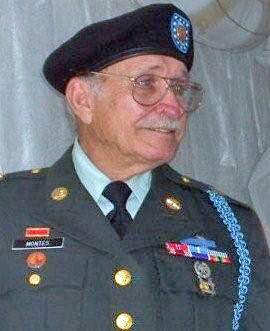
PFC Miguel Montes Ortiz
This account and photographs were submitted to this site by Ana Montes, the proud daughter of PFC Miguel Montes Ortiz.
_____________________________________________________________________________________________________________________
MSgt. Juan Rabelo
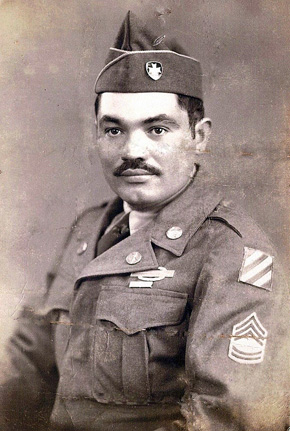
MSgt.
Juan Rabelo, entered the service in 1939 when he was 19. He was born in
Cayey, Puerto Rico. He was in World War II and in Korea, I believe in 1952.
In 1955, he was stationed in Fort Benning, Georgia; from 1956 until 1958, he
was at Fort Bragg, North Carolina where he retired as an E8 Master Sergeant.
We both entered the University of Puerto Rico in 1960 and graduated, cap and
gown in 1964. His BA was in Business Administration.
He was with the 65th Infantry Regiment and very proud to serve in the US
Army. His rank in Korea was sergeant. I remember as if it were yesterday, I
was seven, when the troops left Henry Barracks with an escort of motorcycles
and lights flashing. The soldiers waved to the mothers, wives and children.
It was an ominous day. The sky turned dark and there was total silence
except for the soft crying of the loved ones left behind. The mothers, wives
and children did not know where Korea was located. I used to hear, it was in
the other side of the world. Something that my mother did and perhaps other
moms and wives did, is that they went to the town of Cayey, we did not live
in town, and they walked to check some lists to check the "bajas", the
fallen, KIA. Our mother did not tell us why she went to town every day.
Later on in life, we found out what "bajas" was. My father’s weapon was a
mortar. Later on in life, doctors found out that the prolonged firing of
this weapon impaired his hearing.
This morning I called him and wanted to see how much he remembered of the
Korean War. He remembered a lot. His long-term memory is good. It was
amazing. Papi, we are so proud of you!!!!!
He is eighty-nine; He always talks with such pride of his service in Korea.
Eva Fischer, the proud daughter of MSgt. Juan Rabelo, submitted this anecdote and photos to this site.
Photos
__________________________________________________________________________________________________
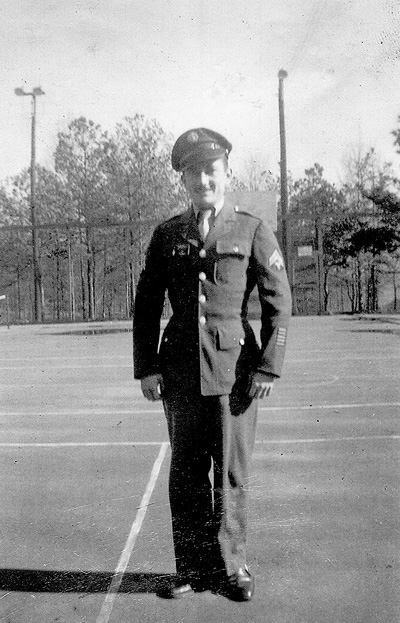
En 1950, estando en Korea del Sur (Pusan) con el Regimiento 65
de Infanteria, sali de pase a la
ciudad desde un barco transporte que
nos llevaria a Korea del Norte. Yo
llevaba puesto un “field jacket”y una gorra de invierno. Llevaba tambien una
carabina. Yendo de regreso al barco una hora despues, senti un tremendo
golpe en la cabeza y cai inconsciente al suelo. Desperte en un hospital del
ejercito donde me informaron que los “MPs”me habian recogido del pavimento
despojado del “jacket”, la gorra y la carabina.
Me retuvieron
unos dias en el hospital. Mientras tanto, el barco partio hacia Korea del
Norte, por lo tanto, fui enviado a un “Collecting Station”en espera de ser
reintegrado a mi compania.
Estando ahi
en espera, escribi a mi padre en PR informandole lo sucedido. Me sorprendio
su respuesta contandome como me “habian llorado”cuando leyeron en el
periodico El Mundo que “Miguel A. Cintron habia muerto en accion”. Se trato
de otro soldado del mismo nombre y apellido que yo. Eventualmente, me
reintegraron a mi compania en Korea del Norte.
- Pedro Jose Diaz
My name is Carolin Gumbel and I am searching for my paternal grandfather. As far as we know, he was a Puerto Rican Soldier who was stationed in Germany until 1945. His name was Pedro Jose Diaz at least that is all we know. As I read about the Film about the 65th infantry Regiment, I began to think that he could have been part of it, since they were stationed in Mannheim/Heidelberg and they left Germany in late 1945. My father was born on 22 April 1946 to Irmgard Emma Kurz. In addition, he has the same name as his father "Peter Josef". My grandfather wrote several notes to my grandmother, but she never replied, he even wanted her to come with him, but she did not want to leave her family. She died when my father was 18, only then did he get to know that his real father was a Puerto Rican Soldier for the US Army. In 1969, my father went to the USA for 3 years visiting his Uncle Erik Kurz who still remembered Pedro Jose. He did not have much information, only that which I have right now. The last address we have is a post office Box in San Juan. According to my father, Pedro could have had blond hair, but Erik was not that sure of his hair color. Erik died as well long ago and thus we cannot get more information. Every chance on getting more information died with him, at least until now. I hope someone can help me, my father, and my brother Lars, find out a little bit more about my grandfather and his children, if he has more children back in the USA. If anyone has any information on Pedro Jose Diaz please contact me at [email protected]
Thank you.
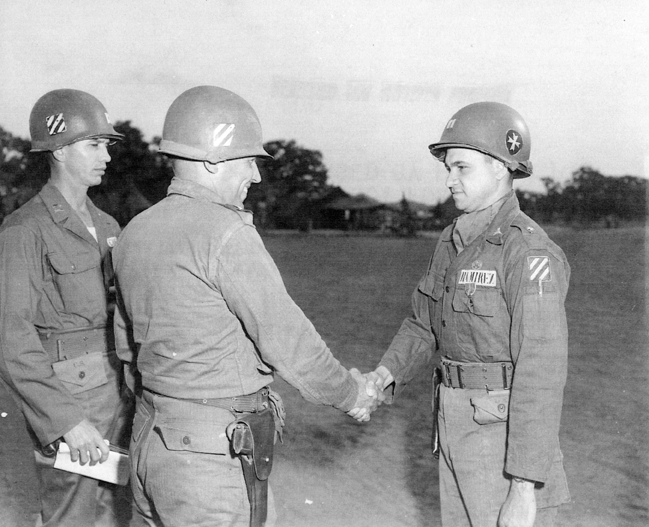
CAPT EMILIO RAMIREZ (SANTURCE, P.R.) (RIGHT) MEDICAL CO,
65TH INF REGT, 3RD U.S. INF DIV, IS CONGRATULATED BY
LT COL THOMAS J GENDRON (COHOES, N.Y.) CO 3RD BN,
65TH INF REGT, AFTER BEING AWARDED THE BRONZE STAR
MEDAL DURING CEREMIONIES HELD AT REGT HQS, KOREA. -
U.S. ARMY PHOTO BY PFC PHILIP PERRONE (SK) 3RD SIG CO

Left to right - Dr. Hector Guitierrez - Tina Guetg de Ramirez - Emilio Ramirez Kohl -
Korean representative - on a trip to Korea by veterans in 1989.
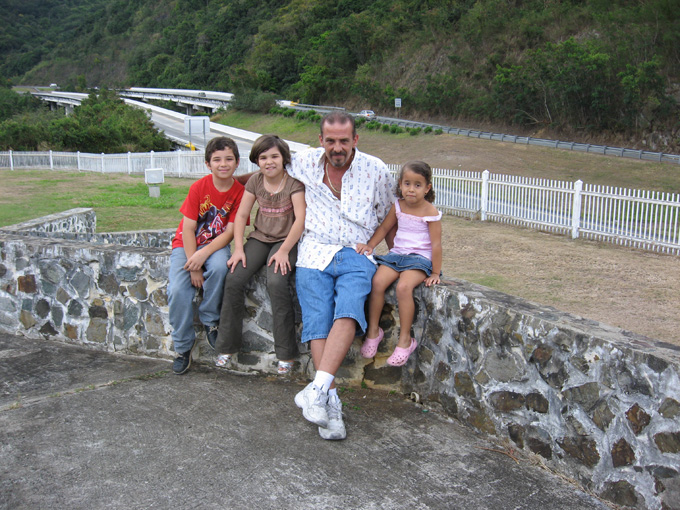
Eduardo Ramirez with three of his five children, this photo and the photos in the slide
show were submitted to this site by Eduardo the son of Captain Emilio Ramirez Kohl.
___________________________________________________________________________________
SFC James E. McCarthy
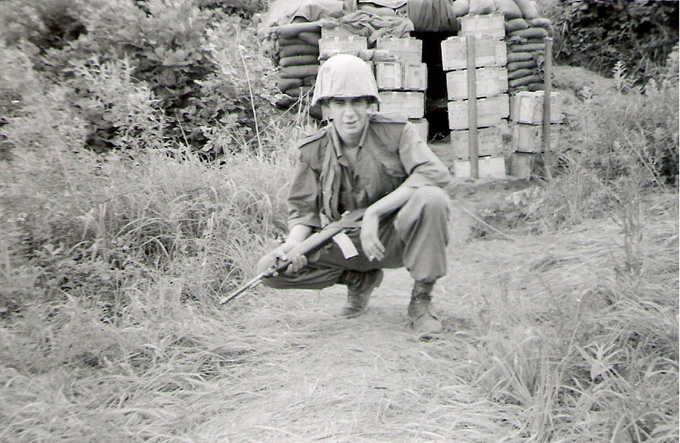
SFC James E. McCarthy - Outpost Harry - Korea - 1953
SFC James E. McCarthy served with the 65th Infantry Regiment, 3rd Infantry Division in Korea. SFC McCarthy served with Companies "B", "D", and Headquarters Company of the First Battalion. He saw combat in the KumwaValley, Outpost Harry, Iron Triangle, and the Kumsong River Valley. Mr McCarthy is a member of the Korean War Veterans of America, Chapter 256 : V.F.W. Post 9021.
Mr. McCarthy has been married to his wife Florence for fifty-seven years; they have six children, sixteen grandchildren, one great grandson. The McCarthy's raised their family in Sterling Heights, Michigan.
SFC James E. McCarthy was the recipient of the following awards and medals.
1. Combat Infantryman Badge
3. Army Good Conduct Medal
4. National Defense Medal
5. Korean Service Medal
6. Un Korean Service Medal
7. ROK War Service Medal
8. United Nations Medal
9. Korean Presidential Unit Citation Medal
10. US Presidential Unit Citation Medal with two Oak Leaf Clusters
11. Navy Medal
12. Greek Bravery Medal
The bio and photos were submitted to this site by James E. McCarthy.
_______________________________________________________________________________________________________________________________
Jose Ernesto Cordero
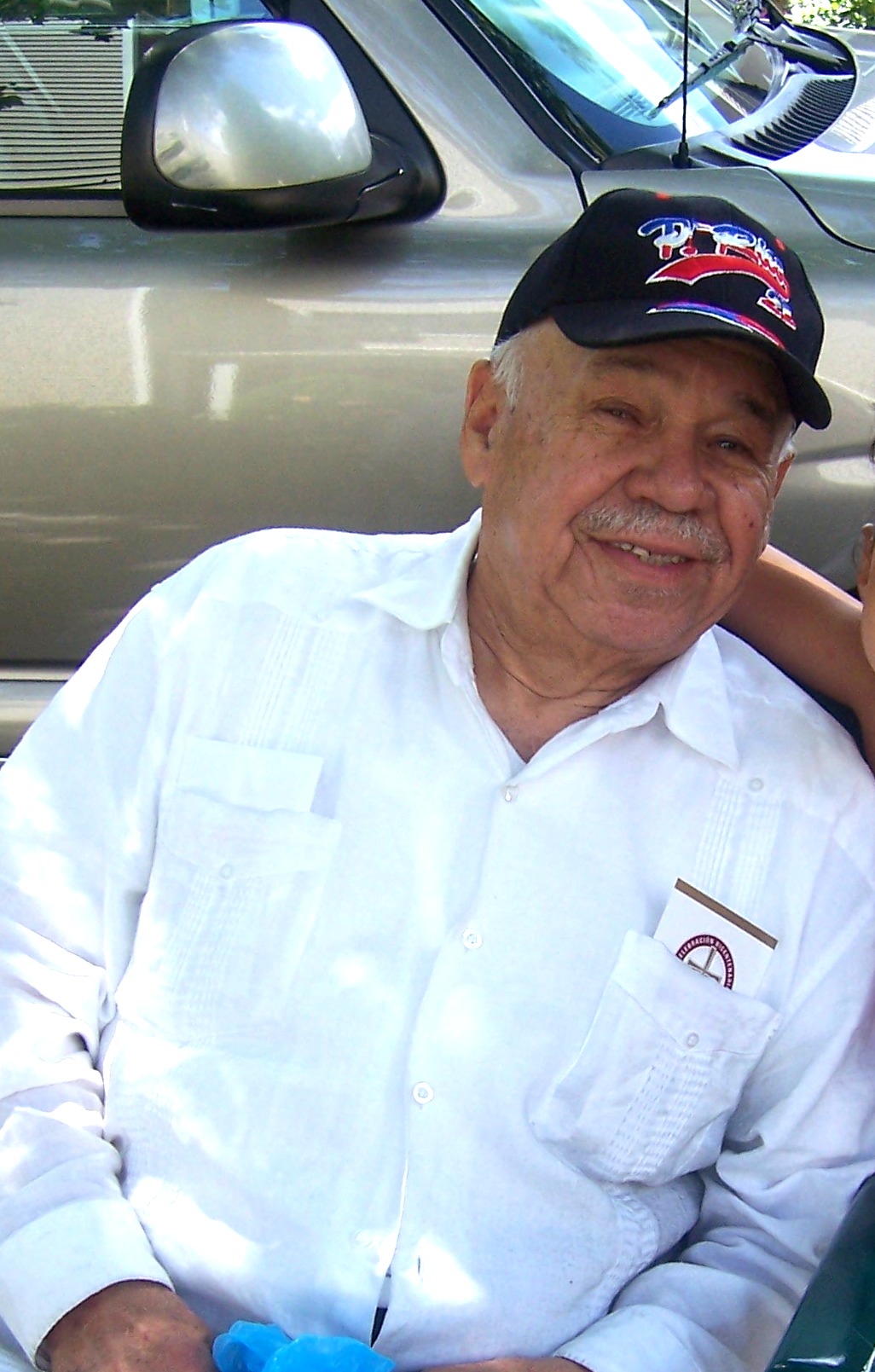
The Cordero Family regretfully informs our Friends and Family of the unexpected passing of our beloved Uncle and Brother Jose Ernesto Cordero on September 11, 2008.
Pilot held as POW after bailing out of crippled plane
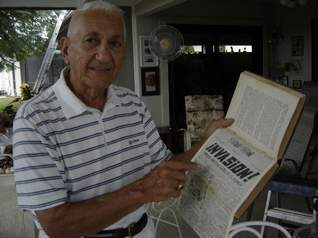
Victor Hernandez shows the secret POW camp newsletter he helped write.
(Pam Harbaugh, FLORIDA TODAY)
_
Letter from former Marine Dave Albert
I was a USMC Reservist called to active duty 28 August 1950. I arrived in Korea with the first and second replacement draft 10 November 1950. I volunteered to be a member of Anglico (Air Naval Gunfire Company) First Signal Battalion. I was at the Chosin with H & S Co, 2dBn, 5th Marine Regiment Naval Gunfire Spot Team. The Army did not have Naval Gunfire Support teams, I was assigned to the Third Army Division, X Corps and specifcally to the 65th RCT to cover the Hungnam fefensive action and evacuation. My team was one of the last to leave and were on the rail of the USNS Freeman when the port was demolished. A great Christmas Eve prestent for us. Major General Edward M. Almond, Commanding X Corps commended the ANGLICO Company on 28 December 1950. In later years I had conversed by telephone and correspondence with then Colonel W.W. Harris. Who had written, and I quote "I am well aware of what you and your comrades of the Naval Gunfire team did for us - only time has caused a slip in memory but I vividly recall that your support was the difference between life and death for some of us." I have the letter and could send a facsimile. In telephone conversation I was led to believe that , now General Harris, was writing up citations for our team. To this date, after many inquiries nothing has materialized consequently my writing to see if anyone remembers our actions during this period. Perhaps there are members that recall and would step forth confirming our involvement during this period. Tried to keep this as simple as possible but upon inquiry could elaborate further. As I had mentioned earlier it was a privledge and a pleasure to have been attached to the 65th. They would have made a "Hell of a good regiment of Marines !!" Puerto Rico has many reasons to be proud of their services!
Semper Fi
Dave Albert -
[email protected]_____________________________________________________________________________________________________________________________________________________________________________________________________________________________________
____________________________________________________________________________________________________________________________________________________________________________________________________________
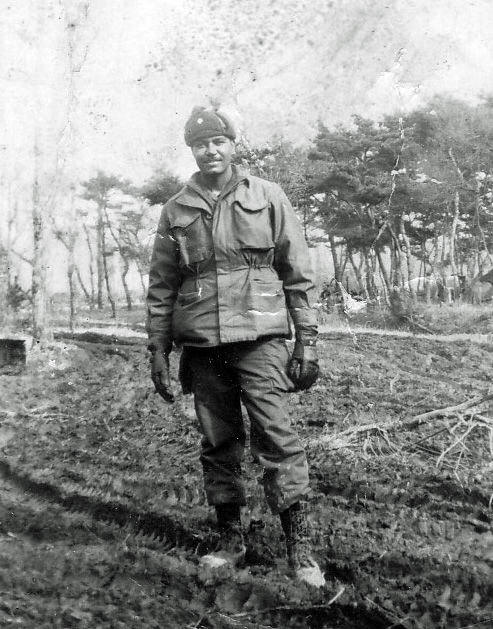
SSGT Claudio Ortiz
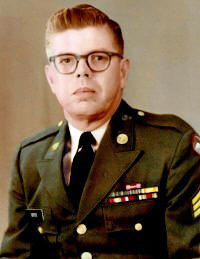
SSGT Claudio Ortiz was born in Barrio Guadiana, Naranjito, Puerto Rico on 6 December 1917. He served in active military service for 24 years, 11 months and 29 days. His military career started on 27 November 1938, when he joined the Puerto Rico National Guard’s 65th Infantry Regiment. On 15 October 1940, the 65th Infantry Regiment was activated to serve with the US Army. Claudio served in the European Theater of Operations from 27 September 1944 to 23 May 1945, where he participated in the Battle of Germany as a rifleman. The all Puerto Rican 65th Infantry Regiment received battle participation credits for the Naples-Foggia, Rome-Arno, Central Europe, and Rhineland campaigns. From 3 January 1946, Claudio served in the Rodriguez Army Hospital as a medical technician. While working in the respiratory ward at the hospital he contracted tuberculosis. Due to his illness, he received a temporary disability retirement on 30 September 1950. After recuperating, Claudio reenlisted on 1 June 1955 and served in the 418th Medical Company (AMB), the 106th General Hospital (Japan), the 27th Surgical Hospital (Vietnam), and the HHB 5th Bn. 57th Arty FBT 4th USA. Claudio’s Foreign Service included: ETO, USAREUR, and USARPAC. Claudio was honorably discharged in Ft. Bliss, Texas on 30 April 1970. His military awards and decorations included: the Combat Infantry Badge, the Bronze Star Medal, the Army Commendation Medal, the Good Conduct Medal (with silver clasp and two loops), the American Defense Medal, the American Campaign Medal, the European-African-Middle Eastern Campaign Medal with bronze star attachment, the World War II Victory Medal, the World War II Occupation Medal with Germany attachment, the National Defense Service Medal with 1st oak leaf cluster attachment, the Vietnam Service Medal with 4 bronze star attachments, the Republic of Vietnam Campaign Medal with attachment, the Republic of Vietnam Gallantry Cross Unit Citation, the Driver and Mechanic Badge with driver W bar, and the Expert Weapons Qualification Badge with rifle bar. Claudio passed away at 11:00 am on 18 November 2008. At his side, was his beloved wife of 64 years, Maria Teresa. Claudio was buried at the Holy Cross Catholic Cemetery in San Antonio, Texas. This information and photograph was provided by Claudio Ortiz's son Ramon E. Ortiz Juan.
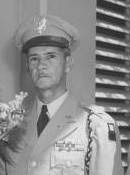 Colonel
Enriquez M. Benitez was a commissioned second Lieutenant in the Puerto
Rico Regiment of Infantry in 1917; he served in that Regiment during
W.W.I. The Puerto Rico Regiment was reorganized in 1920, and was
re-designated the 65
Colonel
Enriquez M. Benitez was a commissioned second Lieutenant in the Puerto
Rico Regiment of Infantry in 1917; he served in that Regiment during
W.W.I. The Puerto Rico Regiment was reorganized in 1920, and was
re-designated the 65
 spitalized at the Bay Pines Veterans Hospital. Upon my
discharge, I went to the National Cemetery office to get everything
straightened out so, when my time is up, my wife won't have any problems. At
the same time, I decided to check with the Graves Registration office about a
good friend of mine with whom I lost contact two years earlier, LTC Luis A.
Tavarez. Graves Registration had no record of him so I assumed he was alive.
Since I am a veteran of the 65th Infantry Regiment, the "Borinqueneers," I
receive bulletins written by Noemi Figueroa who is the producer of the
documentary about the Borinqueneers. I took part in the production. The last
bulletin I received displayed a picture of LTC Tavarez who died in 2007, the
year I lost communication with him. The picture was taken when he was First
Sergeant with K Company of the 65th Regiment. I mourn his loss deeply. LTC
Tavarez introduced me to the Society of the 3rd Division. LTC Tavarez is also
known as "Tingo". I don't know why, but his friends called him that when he
was not in uniform. Tingo was born in San Juan, Puerto Rico. His father had
served his military career for more than 30 years with the 65th, as did my
father, Sgt Manuel Reyes. Our fathers were very close friends so my brothers
and I knew Tingo from the time he was a teenager. When he was 18, he joined
the National Guard of Puerto Rico (296th Infantry Regiment), because it was
very hard to join the Army in the early 1940's. The Army had been reduced to a
few thousand. Tingo became one of the best soldiers and a role model for
others - a good leader, patriotic, and proud to wear the uniform of the U.S.
Army. He rose to the rank of SFC and commanded the National Guard. It was a
very sharp unit. Because of his success with his unit, he became friends with
Colonel Juan Cesar Cordero, who was then Commander of the 296th Infantry.
(Cordero was a veteran officer and Commander of the 3rd Battalion of the65th
during W.W.II.)
spitalized at the Bay Pines Veterans Hospital. Upon my
discharge, I went to the National Cemetery office to get everything
straightened out so, when my time is up, my wife won't have any problems. At
the same time, I decided to check with the Graves Registration office about a
good friend of mine with whom I lost contact two years earlier, LTC Luis A.
Tavarez. Graves Registration had no record of him so I assumed he was alive.
Since I am a veteran of the 65th Infantry Regiment, the "Borinqueneers," I
receive bulletins written by Noemi Figueroa who is the producer of the
documentary about the Borinqueneers. I took part in the production. The last
bulletin I received displayed a picture of LTC Tavarez who died in 2007, the
year I lost communication with him. The picture was taken when he was First
Sergeant with K Company of the 65th Regiment. I mourn his loss deeply. LTC
Tavarez introduced me to the Society of the 3rd Division. LTC Tavarez is also
known as "Tingo". I don't know why, but his friends called him that when he
was not in uniform. Tingo was born in San Juan, Puerto Rico. His father had
served his military career for more than 30 years with the 65th, as did my
father, Sgt Manuel Reyes. Our fathers were very close friends so my brothers
and I knew Tingo from the time he was a teenager. When he was 18, he joined
the National Guard of Puerto Rico (296th Infantry Regiment), because it was
very hard to join the Army in the early 1940's. The Army had been reduced to a
few thousand. Tingo became one of the best soldiers and a role model for
others - a good leader, patriotic, and proud to wear the uniform of the U.S.
Army. He rose to the rank of SFC and commanded the National Guard. It was a
very sharp unit. Because of his success with his unit, he became friends with
Colonel Juan Cesar Cordero, who was then Commander of the 296th Infantry.
(Cordero was a veteran officer and Commander of the 3rd Battalion of the65th
during W.W.II.) 

.jpg)